Understanding EV costs

Thinking about switching to an electric car? From charging and maintenance to salary sacrifice savings, there are several ways driving electric could help reduce your day-to-day motoring costs.
Petrol, Hybrid and Electric running costs compared
In many cases, electric cars can be more cost effective to run than petrol or hybrid vehicles, particularly when charged at home. Individual costs will vary depending on your car, mileage, charging habits and electricity tariff.
Because EVs have fewer moving parts than petrol and diesel cars, they may require less routine maintenance, which can help reduce ongoing servicing costs. Combined with potentially lower energy costs, this can make electric vehicles an attractive option for drivers looking to reduce day-to-day motoring expenses.
| Petrol | Hybrid (HEV) | Electric (EV) | |
| Typical energy costs | Typically, the highest day-to-day fuel costs | Often lower than petrol, depending on driving style and efficiency | Can be significantly lower when charging at home, particularly on off-peak or overnight tariffs |
| Routine maintenance | Typically, highest due to the number of engine and mechanical components | Can be lower than petrol vehicles but still requires maintenance for both petrol and electric systems | Usually lower due to fewer moving parts and reduced servicing requirements |
| Best suited to | Drivers who prefer traditional refuelling | Drivers looking for improved efficiency without regular charging | Drivers looking to reduce day-to-day running costs |
| Things to consider | Fuel prices and fuel efficiency | Fuel prices, fuel efficiency and driving style | Charging costs, charging location and vehicle efficiency |
Illustrative comparison only. Actual running costs will vary depending on the fuel prices, electricity tariffs, charging location, vehicle efficiency and driving habits.
How much could I save by getting an EV?
Based on a driver covering 10,000 miles per year, an illustrative comparison could look like this:
| Vehicle type | Example annual energy/fuel cost* |
| Petrol car | £1,760 |
| Full hybrid | £1,320 |
| Electric car (primarily charged at home) | From £220 |
That’s a potential saving of £1500 a year on energy costs alone compared with an equivalent petrol vehicle.
*Illustrative example only. Actual costs and savings will vary.
What affects EV running costs?
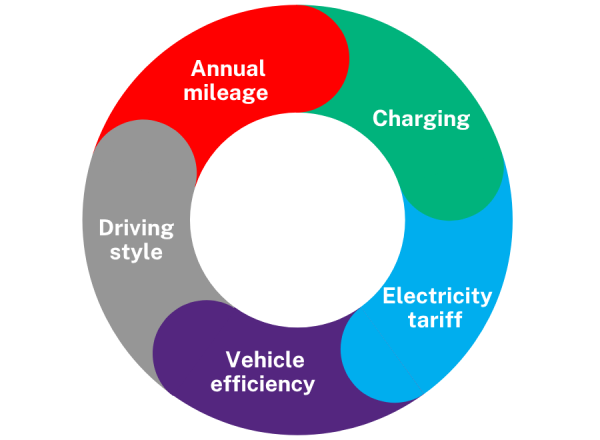
Your cost will depend on:
- How many miles you drive
- Where you charge
- Your electricity tariff
- Your vehicles efficiency
- Your driving style
How salary sacrifice can reduce EV costs
Alongside lower running costs, salary sacrifice can help make driving an electric car more affordable and the amount you save will depend on your individual circumstances and tax position.
When choosing an EV through Tusker’s salary sacrifice scheme, you’ll get:
See how much you could save by driving electric
Use our Journey Cost Calculator, powered by Zapmap, to compare the running costs of electric, petrol and diesel vehicles. Enter your typical journeys, fuel costs and electricity rates to discover your estimated savings and explore whether an EV could be the right choice for you.
Data provided by Zapmap.
Learn about EV charging
Discover the different ways to charge an electric vehicle, whether you’re charging at home or using public charging networks.